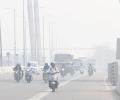
'I think pollution levels have been rising in Delhi for the past 10-12 days. We can feel it in our eyes today. The smog is dense'

The Bandra Kurla Complex area of Mumbai recorded an AQI of 300 and in the Chembur area, AQI of 319 was recorded as 'very poor'.

Firecracker bursting till late Sunday night led to a spike in pollution levels amid low temperatures.

Delhiites woke up on Thursday to a thick envelope of smog as air quality in the national capital and in adjoining regions, dipped into severe category again.

The city's 24-hour average AQI was recorded in the 'poor' category at 265 on Saturday as residents flouted the ban on firecrackers in parts of the national capital ahead of Diwali, according to Central Pollution Control Board's (CPCB) data.

A thin layer of toxic haze hung over Delhi in the morning and the overall air quality index stood at 313 at 9 am. It continued its upward trend and was recorded at 337 at 1 pm.

On Thursday, the overall AQI in Delhi was 312 around 8:30 in the morning.

The overall air quality index was recorded at 426 which falls in the 'severe' category, according to data by the Central Pollution Control Board.

Delhi's overall air quality index (AQI) stood at 463 at 11.30 am, according to the System of Air Quality and Weather Forecasting and Research (SAFAR).

The city's 24-hour Air Quality Index, recorded at 4 pm every day, stood at 418, up from 334 the previous day, and it may trigger stringent restrictions under the third stage of the graded response action plan to mitigate hazardous conditions.
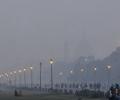
Pollution levels in Delhi during the Diwali period are likely to remain in the higher end of the 'very poor' category in the absence of emissions due to fireworks, the Ministry of Earth Sciences' air quality monitor, SAFAR said.

The air quality in Delhi remained poor Sunday with drop in wind speed even as authorities predicted further fall in air quality index of the national capital in the coming days.

Other Graded Response Action Plan measures like ban on diesel generators, hot mix plants, stone crushers and brick kilns, however, continue to remain in place.

According to SAFAR, both stubble burning in surrounding states of Delhi and firecrackers are causing deterioration of air quality in the national capital.
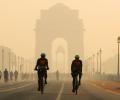
"The overall Delhi's Air Quality Index is in the very poor category with few Delhi locations entering at higher zone but that will be short lived. This is mainly because the extremely calm local surface winds which were prevailing yesterday are likely to increase slightly and may further pick-up by Oct 26," SAFAR said.

It is believed that the crop residue burning in the nearby states of Punjab and Haryana are contributing to polluting the air.

The dip in the air quality can be attributed to low wind speed and temperatures which allowed accumulation of pollutants.
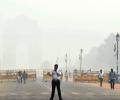
The overall AQI deteriorated further and touched the 268 mark, which falls in the poor category.

The national capital woke up on Tuesday morning to 'severe' air quality under a blanket of thick haze, as pollution levels breached the permissible standards by multiple times.

The official data maintained by the Centre-run System of Air Quality and Weather Forecasting And Research put the condition at severely polluted. The Particulate Matter 2.5 level was recorded at 146 while the PM 10 was at 233 in New Delhi.

In a gross violation of a Supreme Court order, people in several cities burst firecrackers until at least midnight, two hours after the 10 pm deadline. Loud bangs rent the air in New Delhi.

As weather patterns grow more unpredictable due to climate crisis, India is taking a giant leap with "Mission Mausam" to improve weather understanding and forecasting through expanded observation networks, better modeling and advanced tools like AI and machine learning.

With increasing temperature, the toxic ozone levels, which cause a number of health problems especially for asthmatics, have breached the permissible limits in the city, the MET department said on Thursday.

Health expert termed the problems caused due to the rise in pollution as a "medical emergency".

The news may come as a relief to the Delhi government, whose odd-even traffic rule is set to be rolled out from January 1.

After churning across the Arabian Sea for more than 10 days, Biparjoy made landfall near Jakhau Port in Gujarat on Thursday.
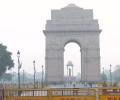
According to forecasting agencies, the city is set to record its best air quality for the day after Diwali since 2015 on Tuesday.

At 9 am on Tuesday, the overall AQI of Delhi docked at 381, which falls in the 'very poor' category.
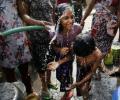
Delhi recorded 8.6 on the UV index on Tuesday while it was 8.2 at noon on Wednesday.

'When you are travelling in Mumbai when the air quality is bad, you feel suffocated.' 'You may feel uncomfortable breathing Delhi air, but the level of discomfort is higher in Mumbai.'
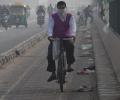
With seasonal crop residue burning, coupled with vehicle emissions, calm winds and low temperatures persisting for some time, the thick layer of toxic smog has hovered over the national capital.

The increase in stubble burning has kicked off a political slugfest, with Union Environment Minister Bhupender Yadav on Wednesday saying that there had been a 19 per cent rise in farm fires over 2021 in Punjab and that the Aam Aadmi Party had turned the national capital into a gas chamber.

People living in the national capital and in states such as Maharashtra, Uttar Pradesh, Madhya Pradesh and Tamil Nadu are more likely to contract COVID-19 due to prolonged exposure to high concentration of PM 2.5, according to a new pan-India study.

Welcoming the reduction in pollution, environmentalists urged the government to treat it as a "wake-up call" and stop its "obsession" with "development" at the cost of the environment.
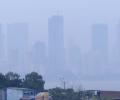
'If we don't control the additional pollutants that come from various human activities then, the pollution level will not come down.'

The national capital on Friday recorded a 24-hour average air quality index of 239. On Thursday, it was 315, the worst since February 12 when the AQI was 320.

Despite legal deterrent in place to discourage people from doing so, by dusk, residents in many neighborhoods, including some areas in south Delhi and northwest Delhi, had started bursting crackers.

The city's air quality index will fluctuate between the higher end of the "poor" category and the lower end of the "very poor" category, it predicted.

Delhi Chief Minister Arvind Kejriwal hopes pollution will not affect the India-Bangladesh T20 International in the city on November 3, emphasising that his government has been taking steps such as the odd-even scheme to improve the air quality.

According to the System of Air Quality and Weather Forecasting and Research, the overall air quality of the national capital docked at 376 at 8:30 am on Tuesday.
 © 2026 Rediff.com - Advertise with us - Disclaimer - Privacy Policy - Sitemap - Feedback - About us - Terms of use - Grievances